You’ve probably heard the terms nearsighted and farsighted used to describe vision. People often use these terms without fully knowing what they mean for their overall eye health. These common labels refer to 2 specific vision conditions—myopia and hyperopia.
In simple terms, myopia, or nearsightedness, makes distant objects look blurry, while hyperopia, or farsightedness, can make close-up items appear out of focus. Each condition affects how your eyes focus light and can influence your daily activities in unique ways.
A Simple Look at Nearsightedness and Farsightedness
Myopia and hyperopia are both related to how your eye focuses. One affects your distance vision, and the other can impact your ability to see things up close.
What Is Myopia (Nearsightedness)?
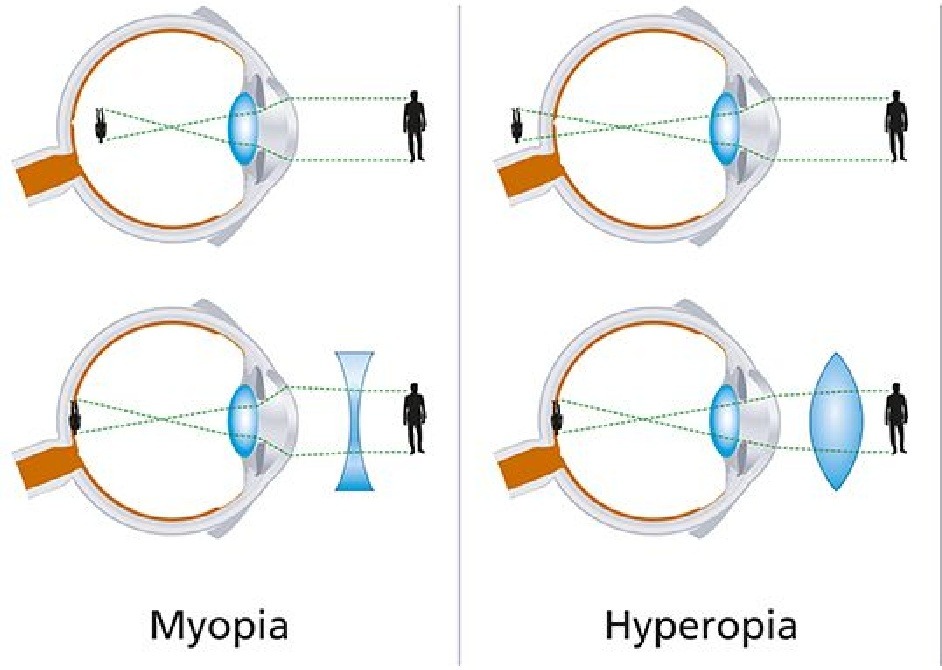
If you have myopia, you can typically see objects nearby quite clearly, but things farther away appear blurry. This happens when your eye’s shape causes light to focus in front of the retina, instead of directly on it. For example, you might be able to read a textbook with ease but struggle to see what’s written on a lecture hall whiteboard.
What Is Hyperopia (Farsightedness)?
Hyperopia is the opposite of myopia. With this condition, you can often see distant objects clearly, but your close-up vision may be blurry. This occurs when your eye focuses images behind the retina. Many young people have mild hyperopia and may not notice any symptoms at first because their eyes can compensate for it.
What Is Presbyopia?
Presbyopia is another common vision condition that affects nearly everyone as they age, usually becoming noticeable after age 40. Unlike myopia or hyperopia, presbyopia isn’t related to the shape of the eye. Instead, it happens when the eye’s natural lens becomes less flexible over time, making it harder to focus on close-up objects.
People with presbyopia may notice difficulty reading small print, needing to hold books or phones farther away, or experiencing eye strain during close work. Presbyopia can occur on its own or alongside myopia or hyperopia and is commonly corrected with reading glasses, bifocals, progressive lenses, or contact lenses designed for multifocal vision.
Signs You Might Have Myopia or Hyperopia
How can you tell if you might have one of these conditions? Your eyes can provide clues based on how you see things at different distances. Paying attention to these signs is a good first step in understanding your vision.
Common Signs of Myopia
- Difficulty seeing distant objects, like a TV screen or road signs
- Needing to squint to see clearly
- Headaches caused by digital eye strain
- Feeling tired when driving or playing sports
- Needing to move closer to objects that appear blurry
Common Signs of Hyperopia
- Close-up objects look blurry or out of focus
- Eye strain or headaches after close work, like reading or using a computer
- Having to squint to see clearly up close
- A feeling of discomfort or fatigue around your eyes
- Needing to move objects further away to see better
But the only way to know for sure which condition you may have is through a comprehensive eye exam with an optometrist.
How These Conditions Affect Your Daily Life
Both myopia and hyperopia can influence everyday activities. For university students managing coursework and families with busy schedules, clear vision is important for everything from studying to driving.
Challenges with Myopia
Myopia can make it difficult to engage in activities that require sharp distance vision. This might affect your ability to follow along with presentations in a large room or recognize a friend from across campus. It can also impact how you enjoy sports or movies.
Challenges with Hyperopia
Hyperopia can create problems with tasks that need sustained focus on nearby objects. It can lead to eye fatigue during long study sessions or make it hard to read a bedtime story without straining. When studying, following the 20-20-20 rule can help reduce strain and make schoolwork feel less tiring.
When Do Vision Changes Typically Appear?
Vision conditions can develop at different times in life. Myopia often shows up during childhood and can shift throughout the school years. Hyperopia, on the other hand, may be present from birth and become more noticeable as you get older.
Myopia in Children and Young Adults
Myopia is frequently first noticed in school-aged children and can progress during the teen years and into early adulthood. This is a key time for students, so tracking these changes is helpful. Scheduling regular children’s eye exams is a simple way to monitor your child’s vision as they grow.
Hyperopia at Different Life Stages
Many children are born with mild hyperopia that they eventually outgrow as their eyes develop. If it’s more significant, it can be identified early on. For adults, hyperopia often becomes more apparent after age 40, as the eye’s natural ability to focus on close objects changes, making adult eye exams increasingly important.
Find Your Path to Clear Vision
If you experience symptoms of myopia or hyperopia, there are straightforward ways to help you see clearly. While these conditions are not reversible, they can be corrected with the right support.
Eyeglasses and Contact Lenses
The most common methods for correcting both myopia and hyperopia are prescription eyeglasses and contact lenses. Eyeglasses are a simple and effective option, while contact lenses offer a wider field of view. Each choice provides different benefits to suit your personal preferences and daily routine.
The Role of a Regular Eye Exam
An eye exam from an optometrist does more than check your vision for a new prescription. It’s also an important way to monitor your overall eye health. This check-up allows for an accurate and personalized prescription tailored to your specific needs.
Talk to an Optometrist in Guelph About Your Vision
A conversation with a professional can help you understand your vision and explore what options may work for you. Clarity Optometry & Vision Care can answer your questions and help find a comfortable solution. Taking this step can put you on the path toward clearer, more comfortable sight. At Clarity Optometry & Vision Care, we’re committed to supporting students and families in the Guelph community. We focus on providing care that is tailored to your unique needs at every stage of life. If you have questions about your vision or are ready for a check-up, we invite you to book an appointment with our team.